

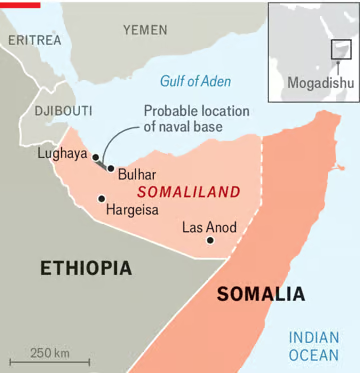
- Somaliland, a de facto independent state since 1991, leverages its Gulf of Aden location and mineral wealth to attract global investors and strategic partners despite lacking UN recognition.
-
A 2024 Ethiopia and Somaliland MOU granting coastal access and potential U.S. military base plans in Berbera highlight its geopolitical value as a counterweight to China’s Djibouti influence.
-
Rich in rare earth elements, lithium, and titanium, Somaliland’s stable governance positions it as a strategic alternative to volatile mining regions, though recognition barriers limit capital access.
-
Investors face high risks from regional tensions and clan-based politics but could benefit from infrastructure-linked opportunities and potential U.S. recognition-driven FDI surges.
In the shadow of the Horn of Africa’s geopolitical chessboard, Somaliland—a de facto independent state since 1991—has quietly positioned itself as a critical player in the 21st-century scramble for resources and strategic alliances. While its international recognition remains elusive, the region’s unique blend of political stability, emerging infrastructure, and untapped mineral wealth is drawing the attention of global powers and investors alike. For those willing to navigate the risks, Somaliland’s strategic offerings represent a rare confluence of geopolitical leverage and economic potential.
Geopolitical Risk: A Calculated Gamble
Somaliland’s lack of formal recognition by the United Nations and most global powers is both its greatest vulnerability and its most potent bargaining chip. The region has leveraged its de facto independence to secure high-stakes partnerships, including a 2024 Memorandum of Understanding (MOU) with Ethiopia, which granted Addis Ababa access to 20 kilometers of coastline in exchange for a potential stake in Ethiopian Airlines and a pledge to recognize Somaliland. This agreement, while contentious with Somalia and the African Union, underscores Somaliland’s ability to extract value from its strategic location on the Gulf of Aden—a critical chokepoint for global trade and counterterrorism operations.
The U.S. has also emerged as a key player, with reports suggesting discussions to establish a military base near Berbera in exchange for recognition. Such a move would not only bolster U.S. maritime security but also counter China’s growing influence in Djibouti, where Beijing operates a military base.
However, the risk of regional destabilization—particularly with Somalia’s vehement opposition—cannot be ignored. The potential for a U.S.-Somaliland alignment could ignite a domino effect in the Horn of Africa, reshaping alliances and trade routes in unpredictable ways.
Critical Minerals: The Next Frontier
While Somaliland’s geopolitical narrative dominates headlines, its mineral wealth remains an underappreciated asset. The region is believed to hold significant deposits of rare earth elements (REEs), lithium, and titanium, essential for green technologies and defense industries. These resources, coupled with Somaliland’s stable governance and low corruption indices, position it as an attractive alternative to politically volatile mining hubs in South America and Southeast Asia.
For example, Somaliland’s coastal and arid hinterlands are rich in titanium deposits, a key component in aerospace and renewable energy applications. With global demand for titanium projected to grow at a 6% CAGR through 2030, early investors in Somaliland’s mining sector could capitalize on a supply chain gap exacerbated by geopolitical tensions in traditional producing regions.
However, the lack of international recognition complicates access to global capital markets, leaving the region reliant on partnerships with entities like the UAE’s DP World, which has already invested $1 billion in the Berbera port to facilitate mineral exports.
Ask Aime: Investing in Somaliland’s rare minerals
Investment Opportunities: Balancing Risk and Reward
For investors, Somaliland’s dual focus on military infrastructure and mineral extraction offers a compelling, albeit high-risk, proposition. The U.S. military’s interest in a Berbera base could catalyze infrastructure development, including roads, energy grids, and logistics hubs, indirectly boosting the mining sector.
Additionally, the potential for U.S. recognition—likely under the Trump administration’s transactional foreign policy—could unlock access to U.S. markets and investment flows, particularly if the U.S. seeks to reduce its reliance on Chinese-controlled supply chains.
However, the path to profitability is fraught with challenges. The Ethiopia-Somaliland MOU, while economically promising, has strained relations with Somalia and the AU, creating legal and diplomatic uncertainties. Investors must also contend with the region’s fragile political ecosystem, where clan-based governance and territorial disputes (such as the 2022 Las Anod conflict) could disrupt operations.
Strategic👌👌 Recommendations for Investors💐💐
Leverage Infrastructure – Linked Opportunities: Prioritize investments tied to infrastructure projects, such as the Berbera port expansion or energy development, which are less sensitive to political shifts and more likely to yield tangible returns.
Diversify Geopolitical Exposure: Consider partnerships with regional actors like the UAE or Ethiopia, which have already demonstrated economic commitment to Somaliland, rather than relying solely on U.S. or Western capital.
Monitor Recognition Timelines: Closely track diplomatic developments, particularly the progress of the U.S. “Somaliland Independence Act” and Ethiopia’s adherence to the 2024 MOU. Recognition, even conditional, could trigger a surge in foreign direct investment (FDI).
Assess Mineral Supply Chain Gaps: Target mineral exploration and processing ventures, particularly in REEs and lithium, where Somaliland’s stable governance and strategic location offer a competitive edge.
Conclusion: A High-Stakes, High-Reward Proposition
Somaliland’s strategic value lies in its ability to bridge the gap between geopolitical ambition and economic pragmatism. While the risks of regional instability and diplomatic isolation are real, the rewards for early movers in its military and mineral sectors are equally significant.
For investors with a long-term horizon and a tolerance for geopolitical volatility, Somaliland represents a rare opportunity to align with a region poised to reshape Africa’s economic and security landscape.
As the world grapples with the dual challenges of resource scarcity and strategic competition, Somaliland’s offerings—mineral-rich, strategically located, and politically resilient—could prove to be a cornerstone of the next era of global investment. The question is not whether Somaliland will matter, but how quickly investors will act to secure their stakes in its future.
Story by Nathaniel Stone
Wednesday, Jul 30, 2025 12:28 am ET
https://www.ainvest.com/news/somaliland-strategic-mineral-military-offerings-gateway-geopolitical-economic-gains-africa-2507/


