Hargeisa – Somaliland’s Minister of Health Development, Hon. Hussein Bashir Hirsi, recently welcomed a high-level delegation from the UN World Food Programme (WFP), led by Representative Hameed Nuru. Joined by senior ministry directors, the summit focused on a comprehensive review and strengthening of the ongoing strategic partnership between the two institutions.
Discussions centered on combating malnutrition by expanding and enhancing the quality of national nutrition services. Both sides underscored the critical importance of implementing the National Nutrition and Food Security Policy to protect vulnerable groups, agreeing to fully align WFP interventions with Somaliland’s core national health priorities.
Minister Hirsi expressed profound gratitude for the WFP’s continuous support, which has been instrumental in safeguarding vulnerable mothers and children. He stressed that future collaborations must prioritize sustainable funding models, reinforce government-led health frameworks, and bolster domestic systems to ensure long-term resilience against food insecurity.
Representative Nuru commended the Ministry’s proactive leadership and reaffirmed the agency’s steadfast commitment to supporting Somaliland’s public health sector. The meeting concluded with a mutual agreement to accelerate joint operational plans, ensuring the delivery of sustainable programs that will drive lasting improvements in the nation’s overall health and nutrition standards.
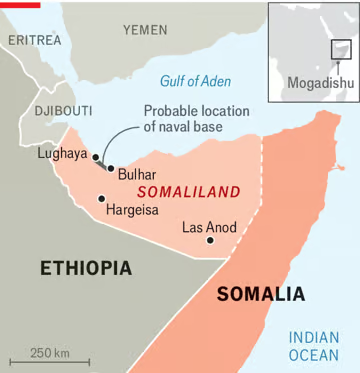
Ottawa, Canada — As the security environment of the Red Sea and Bab el-Mandeb Strait undergoes profound transformation, Somaliland is emerging as an increasingly important partner for regional stability, maritime security, and international trade.
For decades, Somaliland’s quest for international recognition has largely been discussed through legal and diplomatic frameworks. Today, however, geopolitical realities are creating a new context. The growing importance of securing one of the world’s busiest maritime corridors has placed Somaliland’s strategic location, stability, and governance record at the center of regional and international attention.
A Strategic Position Rooted in History.
Somaliland’s strategic significance is not new. During the British Somaliland Protectorate period, the territory served as an essential gateway connecting Africa, the Middle East, and global trade routes. The Port of Berbera was recognized as one of the most valuable maritime assets along the Gulf of Aden.
During the Cold War, both the Soviet Union and the United States recognized Berbera’s importance due to its proximity to the Bab el-Mandeb Strait, one of the world’s most critical maritime chokepoints. Following the collapse of the Somali state in 1991, Somaliland embarked on a successful process of reconciliation, institution-building, and democratic development, creating a stable political environment despite the absence of international recognition.
The Impact of Yemen and Red Sea Security.
The conflict in Yemen and the growing threats to international shipping have significantly altered the geopolitical landscape of the Red Sea. Attacks on commercial vessels, maritime insecurity, and disruptions to global trade have elevated the strategic importance of stable territories capable of supporting maritime security operations.
Without the instability originating from Yemen and the increasing global focus on protecting shipping routes through the Bab el-Mandeb Strait, Somaliland would likely not have reached its current level of strategic relevance. The international community’s growing concern for freedom of navigation has highlighted the importance of reliable partners along the African coast of the Gulf of Aden.
Today, a significant portion of global trade and energy supplies passes through the Bab el-Mandeb corridor. As a result, Somaliland’s geographic location has become an important factor in discussions surrounding the future security architecture of the Red Sea.
Berbera and the Future of Regional Connectivity.
The Port of Berbera has evolved from a commercial port into a major strategic gateway linking Africa to international markets. Investments in infrastructure and regional connectivity have strengthened Somaliland’s position as a potential hub for trade, logistics, and maritime cooperation.
For Ethiopia, Berbera offers an alternative route to the sea and an opportunity to diversify access to international markets. For international partners, Somaliland provides a stable platform for strengthening maritime surveillance, logistics support, and regional security cooperation.
Growing Concerns Over Regional Military Competition.
At the same time, Somalilanders are increasingly concerned by the rising militarization of the region and the growing involvement of external actors in Somalia’s security sector.
Many Somaliland citizens and supporters view Turkey’s extensive military support for Somalia, including the training and development of Somalian armed forces, as a policy that risks increasing regional tensions rather than encouraging a lasting political settlement between Somaliland and Somalia. Concerns are also being raised regarding the broader involvement of foreign powers whose strategic interests may reinforce confrontation instead of promoting peaceful dialogue.
From Somaliland’s perspective, efforts to strengthen military capabilities without addressing the underlying political realities between Hargeisa and Mogadishu risk creating new sources of instability in the Horn of Africa. Somalilanders argue that the region has already experienced the failures of ethno-nationalist politics and centralized state-building projects that have struggled to deliver peace and security for decades.
Many fear that continued geopolitical competition involving Somalia, Djibouti, Turkey, Qatar, and other regional actors could create strategic tensions and governance gaps that hostile actors may exploit. Such developments could ultimately threaten the security of the Red Sea and Bab el-Mandeb Strait, affecting international trade and regional stability.
Recognition Through Strategic Relevance.
As global attention increasingly focuses on securing the Red Sea, Somaliland’s importance is being recognized through practical engagement, economic partnerships, infrastructure investment, and security cooperation.
While formal diplomatic recognition remains unresolved, Somaliland’s contribution to regional stability, secure maritime trade, and political resilience continues to attract growing international interest.
Looking Ahead.
The future of Somaliland is increasingly tied to the evolving security architecture of the Red Sea. As international stakeholders seek reliable partners capable of supporting maritime security and economic connectivity, Somaliland stands ready to contribute to peace, stability, and prosperity across the Horn of Africa.
The international community must closely monitor developments in the region and recognize that sustainable security cannot be achieved solely through military partnerships. Long-term stability requires support for effective governance, peaceful coexistence, economic integration, and respect for the political realities that have emerged over the last three decades.
For Somalilanders, the message is clear: Somaliland is not merely a question of recognition—it is an increasingly important strategic partner in safeguarding one of the world’s most vital maritime
MOGADISHU, Somalia – Members of the Federal Parliament of Somalia, elected from the Puntland State, have issued a strong statement on July 4, 2026, regarding the ongoing security and political unrest they attribute to the former president whose term has ended.
The statement, signed by eight Senators and Members of Parliament from both houses, expresses grave concern over what they describe as unconstitutional actions undermining the federal system and the unity of the country.
Constitutional Term Expired
In the preamble, the MPs affirmed that the constitutional term of the Federal President and other state institutions has expired, creating a political and legal vacuum. They accused the former president, Hassan Sheikh Mohamud, of violating the constitution and the ethics of his office by inciting internal conflicts and funding clan militias.
“The former president is using the name of the Somali National Army to mislead the public, while bearing responsibility for the consequences of mobilizing these militias,” the statement reads.
Condemnation of Actions
The lawmakers explicitly condemned what they termed the “illegal actions” of the former administration, accusing it of damaging the unity of the Federal Republic. They expressed deep concern over the alleged negligence regarding the situation in the Somaliland region and criticized the harsh rhetoric used against the people of Puntland.
Appeals to the Somali People and International Community
The statement makes several key appeals:
· To the Somali people: Urging them, particularly religious scholars, elders, politicians, and civil society, to collectively oppose efforts to destroy national unity, incite internal conflict, and undermine the 2012 constitution. They call for cooperation to facilitate a consensus-based election to end the current legal impasse.
· To the people and government of Puntland: Calling for a unified and solid response to any steps that undermine the federal system, peace, and the existence of the Puntland administration.
· To the international community: Requesting close monitoring of the situation in Somalia, specifically the conflicts initiated by the former president against the regional states.
Conclusion
In conclusion, the MPs called on the Somali public to unite in preserving peace and solidarity and to stand against any irresponsible acts by the former president.
Signatories
The statement was signed by the following Members of Parliament from Puntland:
Hargeisa, Somaliland – Hirsi Ali H. Hassan, the Chairman of Somaliland’s ruling political party, WADDANI, has convened a high-level consultative and information-sharing meeting with a distinguished group of Somaliland academics and professionals who are alumni of various universities across India.
The closed-door session, held in the capital, underscores the party’s commitment to leveraging the vast intellectual capital of the diaspora returnees—particularly those specializing in critical fields such as medicine, engineering, information technology, business administration, and public policy—to drive the nation’s ongoing development agenda.
Strengthening Governance Through Expertise
According to party sources, the meeting centered on integrating the technical expertise of these Indian-educated elites into the government’s existing policy frameworks. As the ruling party, WADDANI is focused on translating its electoral mandate into tangible results, and Chairman Hassan emphasized that these professionals represent a “brain trust” whose exposure to India’s rapidly advancing economy and technological ecosystems could be instrumental in accelerating Somaliland’s journey toward self-reliance, economic diversification, and improved public service delivery.
Discussions specifically addressed how to modernize the national healthcare system, upgrade information technology infrastructure, and revise educational curricula to align with global labor market demands. The Chairman reiterated that the administration is committed to moving beyond rhetoric and actively embedding skilled nationals into state institutions.
A Strategic Shift from Campaigning to Governing
Having secured leadership, the WADDANI administration is now under pressure to deliver on its campaign promises. This meeting signals a deliberate shift from electoral politics to performance-driven governance. Political analysts view the engagement as a clear signal that the ruling party intends to build a technocratic, merit-based administrative culture, reducing reliance on traditional patronage networks and instead prioritizing competence and innovation.
Chairman Hassan framed the session as part of a broader national dialogue, stating that Somaliland’s quest for international recognition and economic takeoff depends heavily on how effectively it utilizes its homegrown talent. He called on the intellectuals to move beyond passive observation and become active partners in co-authoring the country’s next phase of development.
Tapping into the Indian Alumni Network
India has long been a premier destination for Somalilanders seeking affordable, high-quality tertiary education. Over the decades, thousands have graduated from Indian institutions in fields that are often critically undersupplied in the Horn of Africa. However, many of these highly qualified individuals have historically faced underemployment or have been lost to brain drain. During the meeting, the alumni voiced their expectations for structured government programs that would absorb their skills, particularly in public health, urban planning, and digital governance.
Formation of a Presidential Advisory Council
Sources familiar with the discussions revealed that the gathering concluded with a mutual agreement to formalize a standing advisory council composed of these Indian-educated experts. This proposed body would function as a non-partisan think-tank attached to the presidency, providing actionable, data-driven insights on economic resilience, foreign direct investment, and infrastructure megaprojects.
In his closing remarks, Chairman Hirsi Ali H. Hassan reaffirmed the ruling party’s unwavering commitment to transparent and inclusive governance. He assured the professionals that their recommendations would not gather dust but would be fast-tracked into actionable executive policies, reinforcing the administration’s pledge to build a peaceful, prosperous, and internationally recognized Somaliland—a vision now being shaped not just by politicians, but by the brightest minds the nation has produced.
BAIDOA, Somalia – July 6, 2026 – Loud explosions and the roar of low-flying warplanes rattled the southwestern Somali city of Baidoa on Monday morning, as Turkish F-16 fighter jets conducted airstrikes on the city’s outskirts, according to multiple local witnesses and security sources.
Residents reported hearing heavy blasts and sustained heavy-weapons fire in the areas surrounding the city. The airstrikes occurred just hours before the inauguration ceremony for Southwest State President Sheikh Aden Mohamed Nur (Madoobe), which was attended by a high-level delegation from the Federal Government of Somalia (FGS), including President Hassan Sheikh Mohamud.
While Somali officials have not officially commented on the military operation, local analysts view the deployment of Turkish combat aircraft as a direct security measure to protect federal leaders from potential attacks by opposition-aligned forces, particularly those loyal to ousted Southwest President Abdiaziz Laftagareen.
Turkey’s Expanding Military Role
The use of F-16s over Baidoa marks a significant escalation in Turkey’s direct military involvement in Somalia. Ankara already operates its largest overseas military training base in Mogadishu and has regularly deployed drones and fighter jets to support FGS offensives. However, conducting airstrikes to secure a domestic political ceremony signals a shift from counterterrorism operations to internal power-brokering.
Turkey’s support for President Mohamud is well-documented. Critics charge that Ankara is providing unconditional military backing to keep Mohamud in power, despite his constitutional term having officially expired in May 2026. The president has cited controversial constitutional amendments to justify remaining in office until May 2027—a move the opposition rejects as an unlawful extension.
The Natural Resources Factor
Somalia’s federal government has granted Turkey extensive exploration rights over the country’s offshore hydrocarbon reserves. In 2024, Ankara’s state-owned TPAO secured rights to three large exploration blocks, and in 2026, Turkey began historic offshore drilling in Somali waters. When questioned about ceding such rights, President Mohamud famously remarked: “Who else do we have besides Turkey? Who else wants us, supports us?”
This quid-pro-quo arrangement—security for resources—has deepened Turkish leverage over Mogadishu’s political calculus.
Risks of Deepening Turkish Interference
As Turkish jets patrol Somali skies, regional observers warn of several grave risks:
· Erosion of Sovereignty: Critics argue that Turkey is constructing a “parallel state” in Somalia, operating foreign-run military assets without clear parliamentary oversight, effectively reducing Somalia to a client state.
· Exacerbated Political Crisis: Ankara’s open backing of Mohamud’s contested term extension has alienated opposition figures and regional states, deepening the rift between Mogadishu and federal member states. The violent clashes already seen in Mogadishu and Baidoa could spiral into broader inter-clan and inter-regional conflict.
· Proxy Conflict Arena: With Turkey formally designating Somalia’s territorial integrity as a national security interest, Somali soil risks becoming a theater for external rivalries, particularly with Gulf states and other regional actors who view Ankara’s expansion with suspicion.
· Weaponization of Aid: Development projects—hospitals, roads, and military training—are increasingly viewed by skeptics as tools for strategic control rather than genuine partnership, undermining long-term trust between Somali citizens and their government.
Conclusion
Monday’s airstrikes in Baidoa lay bare a troubling reality: foreign military power is now being used to settle domestic political disputes in Somalia. As President Mohamud extends his stay in office with Turkish F-16s overhead, the international community faces a stark choice—remain silent as Somali sovereignty is hollowed out, or demand a return to constitutional order and genuine national reconciliation before the country slides further into crisis.
GAROWE, Somalia, July 5, 2026 – Somalia’s northeastern Federal Member State of Puntland has issued a formal warning to SOMTURK and all other foreign and domestic entities against conducting commercial or security operations within its territorial waters and on its land without prior authorization from regional authorities.
In a press statement released on Sunday, the Puntland administration declared that no company—whether foreign, privately owned, or state-linked—is permitted to engage in activities such as fishery investments, coastal protection, or any other maritime and terrestrial operations within Puntland’s jurisdiction without an official license and approval from the relevant Puntland agencies.
The statement explicitly named SOMTURK, a joint Somali-Turkish entity established in late 2025, which the Federal Government has designated to manage licensing for foreign fishing vessels operating in Somalia’s Exclusive Economic Zone.
Constitutional Basis
Puntland grounded its directive in Articles 44, 51, 52, 53, 54, and 142 of Somalia’s 2012 Provisional Federal Constitution, as well as Articles 4 and 54 of the Puntland State Constitution. The regional administration argued that federal institutions lack the legal mandate to unilaterally issue concessions, grant licenses, or enter into investment agreements concerning resources located within Puntland’s land and maritime boundaries.
The regional state noted that while Somalia has formally adopted a federal system of governance, negotiations to finalize the constitutional division of powers between the central government and member states remain ongoing. Puntland maintains that until this framework is completed, federal authorities cannot bypass regional consultation on matters affecting Puntland’s resources.
Resource Ownership and Federalism
Puntland emphasized that under its own constitution, the natural resources found within its territory belong to the people of Puntland, and the regional government bears constitutional responsibility for their administration and beneficial utilization. The administration reiterated its commitment to the federal system but insisted that cooperation and mutual consultation—as stipulated in the federal charter—must guide all resource-related decisions between Mogadishu and the member states.
The statement further asserted that any agreements or licenses issued by the Federal Government regarding Puntland’s territories without prior consultation are legally invalid and carry no binding effect.
Enforcement and Consequences
The regional administration issued a clear warning that any individual, company, or entity found operating within Puntland’s waters or on its land without proper authorization from Puntland authorities will be subject to inspections, formal investigations, and legal enforcement measures in accordance with regional laws.
Commitment to Investment
Despite its firm stance, Puntland reaffirmed its openness to foreign investment and international partnerships. The administration stated that it welcomes sustainable and lawful investment cooperation, provided that such engagements fully respect Somalia’s federal constitutional framework and explicitly recognize Puntland’s constitutionally guaranteed authority. Puntland stressed that it highly values partnerships founded on transparency, mutual respect, and adherence to the rule of law.
Background and Political Context
The declaration comes amid broader tensions between Garowe and Mogadishu over revenue-sharing, resource control, and the devolution of powers—issues that have strained relations between federal and regional authorities in recent years. Türkiye has emerged as one of Somalia’s closest international allies, maintaining its largest embassy in Africa and a significant military training presence in the country.
The Federal Government of Somalia had not issued an immediate public response to Puntland’s latest warning at the time of publication.
HARGEISA — The Chairman of the ruling WADDANI Party, Mr. Hirsi Ali Hassan, has stated that the Republic of Somaliland does not need division or factionalism, but rather unity and cohesion to achieve sustainable development and strong governance.
Chairman Hirsi emphasized that life is built on resilience, progress, development, and mutual support—principles that serve as the foundation for individual, community, and national advancement.
The WADDANI Party leader also called upon the citizens of the Republic of Somaliland to safeguard their nationhood and actively work to correct and rectify any misguided perspectives. He urged collective effort in matters related to Somaliland’s international recognition, while strengthening national solidarity and unity.
“This nation does not need those who divide or fragment it; we can only succeed through unity. Life is not sustained without resilience, progress, and having support to achieve what you desire. To the people of Somaliland, I call upon you to protect our statehood, to correct and realign our approach to international recognition, and to exercise mutual tolerance,” said WADDANI Party Chairman Hirsi Ali Hassan.
The ruling party leader also announced that new politicians, leaders, and officials who have joined the party are being welcomed as the people’s long-held aspirations for recognition—which they have awaited for 35 years—begin to materialize. Chairman Hirsi further stated that the efforts toward recognition will be completed and elevated to the level where Somaliland takes its seat at the United Nations and becomes a global leader.
“We welcome you as the people’s hope for recognition—which citizens have awaited for 35 years—has now come to fruition. We welcome the recognition process that has begun, and we will complete it until we reach the highest level, with Somaliland seated at the United Nations, setting a precedent for the world and leading the way,” he said.
Finally, Hirsi Ali Hassan and the WADDANI leadership warmly welcomed the new members and officials who have joined the party, representing the regions of Maroodijeex and Gabiley. Among them were former Somaliland Minister of Justice Ahmed Farah Cadarre and Ms. Fadumo Said Ibrahim, who have officially become members of the WADDANI Party.
HARGEISA – The Somaliland judiciary has embarked on a sweeping transformation after delegates at the National Judiciary Conference unanimously approved a comprehensive reform agenda with a 97% majority vote. The landmark two-day conference, held on 28–29 June at the Mansoor Hotel in Hargeisa, set the course for a modern, independent, and accountable judicial system for 2026–2029.
Supreme Court Chairman and head of the Judicial Commission, Adam Haji Ali Ahmed, issued a binding circular on 4 July mandating the immediate dissemination and implementation of all resolutions. The directive applies to all regional courts, prosecution offices, police commands, custodial corps, and legal associations across Somaliland.
The conference builds directly upon the National Justice Conference of December 2025 and aligns with a presidential circular from February 2026, which called for a coordinated restructuring of the justice sector.
Institutional Strengthening and Judicial Independence
To reinforce judicial autonomy, the conference approved expanding the Supreme Court bench to thirteen judges to clear mounting case backlogs. The Judicial Commission will receive enhanced administrative powers, increased budgetary allocations, and expanded regional offices to strengthen oversight, manage complaints, and uphold judicial ethics and performance standards.
Recognizing that independence requires adequate compensation, delegates approved a phased salary increase for judges and court staff, alongside a dedicated retirement and welfare system designed to retain experienced professionals and reduce vulnerabilities to corruption and external influence.
Technology, Infrastructure, and Training
A modern digital Case Management System will be rolled out across all justice institutions, integrating the Police, Attorney General’s office, Courts, and Custodial Corps. The system will handle case registration, evidence management, scheduling, enforcement tracking, and data sharing to minimize delays and improve transparency.
The conference also approved the establishment of the Somaliland Justice Training Institute, which will serve as the national hub for professional development. The institute will provide induction, ethics, leadership, and specialized training for judges, prosecutors, investigators, lawyers, and court staff.
Infrastructure received equal priority, with plans to construct, modernize, and equip courts, police stations, prosecutors’ offices, and custodial centers across all regions. Improvements to transport, internet connectivity, and courtroom technology are also expected to enhance access to justice nationwide.
Accountability, Law Enforcement, and Legal Reform
To rebuild public trust, the conference mandated independent complaint mechanisms covering all justice institutions, with annual accountability reports to be published. Police investigative capacity will be strengthened through modern forensic training, improved crime scene management, and better cooperation with prosecutors.
On enforcement, the Ministry of Interior—collaborating with the judiciary, police, and prosecution—will establish unified national procedures for executing court judgments, with quarterly monitoring reports to ensure compliance.
The conference identified legal reform as fundamental to progress, ordering a comprehensive review and amendment of more than fifteen key statutes. These include the Judiciary Organization Law, Evidence Law, Penal Code, Civil Code, Anti-Terrorism Law, and legislation addressing gender-based violence (SGBV), juvenile justice, and notarial services. The revision process will involve broad consultation with legal professionals, universities, civil society, traditional leaders, and religious scholars to ensure alignment with constitutional guarantees and international standards.
Unifying Reform Efforts
Delegates emphasized that the June resolutions are fully complementary to the December 2025 Justice Conference outcomes, together forming a single, unified reform trajectory for the sector.
“The conference affirms that an independent, efficient, transparent, accountable judiciary with adequate capacity and resources is the most important pillar for upholding the Constitution, promoting economic development, lasting peace, and strengthening the rule of law in Somaliland,” the final resolution stated.
The approved reforms are now legally binding, with the 4 July circular requiring all judicial and law enforcement bodies to begin implementation without delay.
HARGEISA — President Abdirahman Mohamed Abdullahi (Cirro) convened a pivotal meeting today with the National Electoral Commission (NEC) to deliberate on expediting the rollout of a modern voter registration system. The initiative aims to bolster the nation’s democratic framework and reinforce public confidence in the electoral cycle.
During the session, the NEC presented a comprehensive operational blueprint, complete with technical protocols and a detailed implementation schedule for the new digital registration rollout across all regions and districts of Somaliland.
The commissioners elaborated that the new system leverages cutting-edge technology and modern expertise to guarantee a registration process that is precise, transparent, and fully aligned with international benchmarks. This upgrade is expected to streamline eligible citizens’ participation and significantly enhance the overall integrity of the democratic and electoral procedures.
The Head of State commended the Commission members for their relentless efforts in advancing the country’s registration and electoral systems. He urged them to maintain their momentum to ensure comprehensive, high-quality registration reaches every eligible voter.
President Cirro underscored that establishing a modern voter registry is a cornerstone for strengthening democratic governance, safeguarding citizens’ constitutional rights, and ensuring elections that are free, fair, and garner widespread public trust.
He further assured the commissioners that the government stands ready to meet its financial commitments toward the successful implementation of this new voter registration exercise.
The high-level talks concluded with a consensus on bolstering inter-agency collaboration, fast-tracking the technical and administrative phases of the new system, and harnessing modern technology to further cement Somaliland’s reputation for conducting peaceful, transparent, and credible elections.
Hargeisa – Somaliland’s political arena has long been defined by its dynamic volatility—a landscape where shifting alliances and emerging power blocs frequently reshape the national discourse. However, as the public mood grows increasingly introspective, the historical records of prominent political figures are being re-examined with heightened scrutiny. At the center of this renewed focus is , the former Minister of Aviation and Air Transport, Mahmoud Hashi,” whose tenure continues to provoke fierce debate. From his role in the late Ahmed Silanyo’s administration to his recent forays into contemporary political maneuvering, Hashi’s career is now being dissected through the dual lenses of fiscal probity and ideological sincerity.
The Corruption Allegations: A Pattern of Systematic Mismanagement
Throughout his ministerial tenure, Xaashi became a lightning rod for accusations regarding the dissipation of public assets. Critics argue that his time in office was not merely marked by administrative inefficiency, but by a calculated exploitation of state resources. Three major infrastructural projects stand out as the most damning indictments of his legacy.
The Egal International Airport Fiasco
Perhaps the weightiest allegation against Xaashi concerns the ambitious expansion and modernization project for Hargeisa’s Egal International Airport. Intended to transform the facility into a regional aviation hub that could rival neighboring states, the project was reportedly allocated hundreds of millions of dollars from international lenders and national reserves. However, investigative reports suggest that a significant portion of these funds was systematically diverted or outright embezzled, leaving the airport with incomplete terminals and outdated equipment. To this day, the botched modernization stands as a glaring symbol of unaccountable governance, with no tangible recovery of the lost capital.
The Capitulation of Somaliland’s Airspace
In a move that ignited widespread consternation among the public and legal experts alike, Hashi is accused of unilaterally signing an agreement that transferred the management of Somaliland’s sovereign airspace to the Federal Government of Somalia in Mogadishu. Legal scholars and political stakeholders have condemned this decision as a profound betrayal of Somaliland’s quest for international recognition, effectively undermining the territory’s jurisdictional autonomy. In exchange for this contentious concession, reports indicate that Xaashi personally received substantial “consultancy fees”—a term widely perceived as a euphemism for personal enrichment at the expense of national sovereignty.
The Huboweyne Water Project – A Dried-Up Lifeline
Beyond aviation scandal , Hashi’s oversight of developmental aid has also drawn sharp criticism. The Huboweyne water expansion initiative, generously funded by Gulf states to alleviate chronic water shortages in Hargeisa, was envisioned as a lifeline for marginalized communities. Yet, the project floundered amid opaque procurement processes and severe administrative negligence. With the funds depleted and the infrastructure incomplete, the city’s poorest districts continue to endure acute water scarcity. Activists argue that this mismanagement represents a direct assault on the welfare of ordinary citizens, illustrating how elite corruption perpetuates everyday suffering.
The Emergence of a New Political Identity: Hypocrisy as a Strategy?,”
While Hashi’s financial controversies have long been a matter of public record, his recent political conduct has introduced a perplexing new variable to his public persona. Observers note a stark departure from his traditionally reserved demeanor, replaced by an overtly confrontational rhetoric aimed at the current administration.
Specifically, Mahmoud Hashi,” has recently made public statements that appear designed to exploit the nascent divisions between President Irro and his predecessor, Muse Bihi Abdi. By pivoting his allegiances and weaving a narrative of discord between the two leaders, Hashi seems to be employing a calculated strategy of political triangulation. Analysts suggest this tactical shift is a desperate bid to remain relevant in an evolving political order, leveraging wedge issues to fracture the ruling establishment while positioning himself as a potential kingmaker.
“This orchestrated campaign of divisive rhetoric is a face we have never seen from Mahmoud Hashi,” Whether it is a genuine ideological awakening or a cynical ploy to escape accountability for his past, remarked a local political analyst. Mahmoud Hashi,”l ploy to escape accountability for his past, it signals a deepening of the political rot. Hypocrisy, when weaponized by a figure with such a checkered past, threatens to erode the very fabric of our democratic dialogue.”
Concluding Analysis: A Public No Longer Fooled
Somaliland’s political institutions are undeniably navigating one of the most fragile periods in their recent history, grappling with internal governance crises while striving for external legitimacy. However, one critical variable has shifted: the Somali electorate is no longer passive. The citizenry, acutely aware of their leaders’ historical footprints, are demonstrating a newfound political maturity—holding figures like Mahmoud Hashi,” accountable for both their administrative blunders and their rhetorical flip-flopping.
For Hashi, the fundamental questions remain unanswered. Can a politician dogged by allegations of massive embezzlement credibly rehabilitate his image through divisive theatrics? And can the public trust a figure whose loyalty appears contingent upon political expediency rather than principled statecraft?
As the dust settles on these revelations, one thing is certain: Somaliland’s watchful populace will be demanding more than just speeches. They will be demanding transparency, accountability, and a decisive break from the murky tactics of the past. Whether Hashi can meet that demand—or whether history will consign him to the annals of infamy—remains to be seen.