

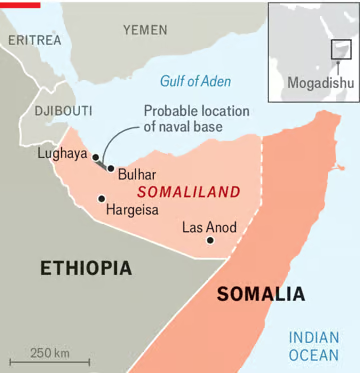
Ottawa, Canada — As the security environment of the Red Sea and Bab el-Mandeb Strait undergoes profound transformation, Somaliland is emerging as an increasingly important partner for regional stability, maritime security, and international trade.
For decades, Somaliland’s quest for international recognition has largely been discussed through legal and diplomatic frameworks. Today, however, geopolitical realities are creating a new context. The growing importance of securing one of the world’s busiest maritime corridors has placed Somaliland’s strategic location, stability, and governance record at the center of regional and international attention.
A Strategic Position Rooted in History.
Somaliland’s strategic significance is not new. During the British Somaliland Protectorate period, the territory served as an essential gateway connecting Africa, the Middle East, and global trade routes. The Port of Berbera was recognized as one of the most valuable maritime assets along the Gulf of Aden.
During the Cold War, both the Soviet Union and the United States recognized Berbera’s importance due to its proximity to the Bab el-Mandeb Strait, one of the world’s most critical maritime chokepoints. Following the collapse of the Somali state in 1991, Somaliland embarked on a successful process of reconciliation, institution-building, and democratic development, creating a stable political environment despite the absence of international recognition.
The Impact of Yemen and Red Sea Security.
The conflict in Yemen and the growing threats to international shipping have significantly altered the geopolitical landscape of the Red Sea. Attacks on commercial vessels, maritime insecurity, and disruptions to global trade have elevated the strategic importance of stable territories capable of supporting maritime security operations.
Without the instability originating from Yemen and the increasing global focus on protecting shipping routes through the Bab el-Mandeb Strait, Somaliland would likely not have reached its current level of strategic relevance. The international community’s growing concern for freedom of navigation has highlighted the importance of reliable partners along the African coast of the Gulf of Aden.
Today, a significant portion of global trade and energy supplies passes through the Bab el-Mandeb corridor. As a result, Somaliland’s geographic location has become an important factor in discussions surrounding the future security architecture of the Red Sea.
Berbera and the Future of Regional Connectivity.
The Port of Berbera has evolved from a commercial port into a major strategic gateway linking Africa to international markets. Investments in infrastructure and regional connectivity have strengthened Somaliland’s position as a potential hub for trade, logistics, and maritime cooperation.
For Ethiopia, Berbera offers an alternative route to the sea and an opportunity to diversify access to international markets. For international partners, Somaliland provides a stable platform for strengthening maritime surveillance, logistics support, and regional security cooperation.
Growing Concerns Over Regional Military Competition.
At the same time, Somalilanders are increasingly concerned by the rising militarization of the region and the growing involvement of external actors in Somalia’s security sector.
Many Somaliland citizens and supporters view Turkey’s extensive military support for Somalia, including the training and development of Somalian armed forces, as a policy that risks increasing regional tensions rather than encouraging a lasting political settlement between Somaliland and Somalia. Concerns are also being raised regarding the broader involvement of foreign powers whose strategic interests may reinforce confrontation instead of promoting peaceful dialogue.
From Somaliland’s perspective, efforts to strengthen military capabilities without addressing the underlying political realities between Hargeisa and Mogadishu risk creating new sources of instability in the Horn of Africa. Somalilanders argue that the region has already experienced the failures of ethno-nationalist politics and centralized state-building projects that have struggled to deliver peace and security for decades.
Many fear that continued geopolitical competition involving Somalia, Djibouti, Turkey, Qatar, and other regional actors could create strategic tensions and governance gaps that hostile actors may exploit. Such developments could ultimately threaten the security of the Red Sea and Bab el-Mandeb Strait, affecting international trade and regional stability.
Recognition Through Strategic Relevance.
As global attention increasingly focuses on securing the Red Sea, Somaliland’s importance is being recognized through practical engagement, economic partnerships, infrastructure investment, and security cooperation.
While formal diplomatic recognition remains unresolved, Somaliland’s contribution to regional stability, secure maritime trade, and political resilience continues to attract growing international interest.
Looking Ahead.
The future of Somaliland is increasingly tied to the evolving security architecture of the Red Sea. As international stakeholders seek reliable partners capable of supporting maritime security and economic connectivity, Somaliland stands ready to contribute to peace, stability, and prosperity across the Horn of Africa.
The international community must closely monitor developments in the region and recognize that sustainable security cannot be achieved solely through military partnerships. Long-term stability requires support for effective governance, peaceful coexistence, economic integration, and respect for the political realities that have emerged over the last three decades.
For Somalilanders, the message is clear: Somaliland is not merely a question of recognition—it is an increasingly important strategic partner in safeguarding one of the world’s most vital maritime


